Design
The python package is just a pybind11 wrapper around the C++ code. The C++ code is designed in the following hierarchy:
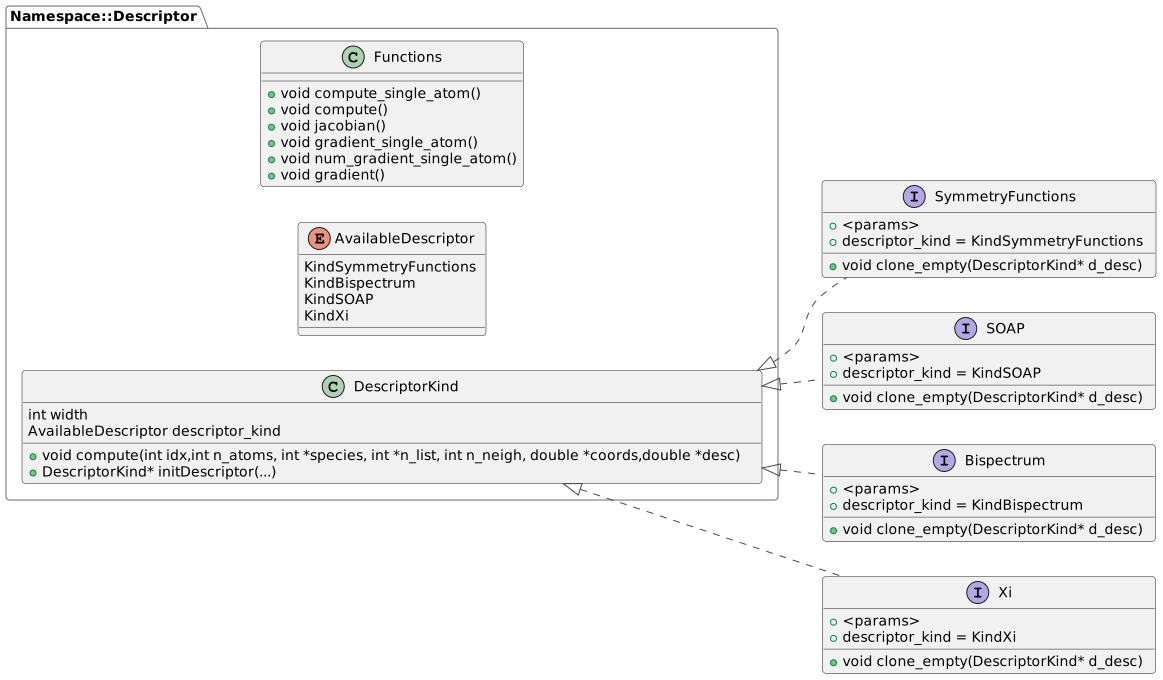
UML diagram of the C++ code
Here namespace Descriptor contains the main DescriptorKind class, enumerated types for
supported descriptor types (AvailableDescriptors and all the utility functions for descriptor
generation and manipulation.
The DescriptorKind class is the main class that is used to generate descriptors, and it is
interfaced by the individual descriptor classes. It is done by inheriting from the DescriptorKind
and implementing the pure virtual function, DescriptorKind::compute. Hence all of the computational
work is done in the DescriptorKind::compute function. compute implements calculation for a single atomic environment,
and gradients are generated automatically in the Descriptor::gradient and Descriptor::gradient_single_atom functions.
To ensure that your implemented descriptor class does get differentiated, you need to hook it in the Descriptor::compute... and
Descriptor::gradient... functions. This is done by adding a new case in the switch statement in the Descriptor::compute... and
Descriptor::gradient... functions. You would also need to implement appropriate DescriptorKind::initDescriptor overloaded function.
This is done so that at runtime any descriptor can be initialized with the DescriptorKind class, and the individual
descriptors implementations are abstracted away. This ensures a more portable implementation for end user cases.
For hooking the gradient function you also need to implement a clone_empty function in your descriptor class. This is used to
generate a __enzyme_virtual class for the gradient computation. This class contains gradients against all of your class members
but currently this class is deleted post computation. In future releases I plan to provide a way to access these gradients as well.
Please let me know if you have any questions or need help with implementing a new descriptor.